
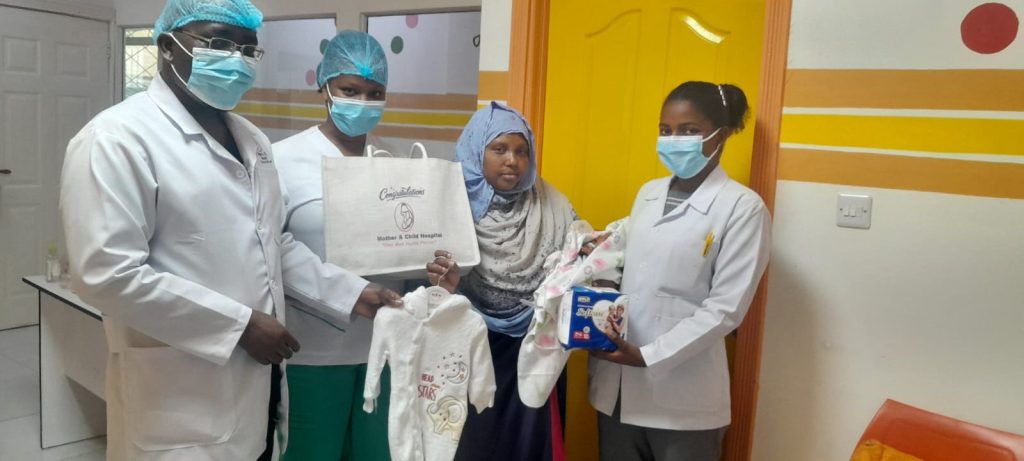
The Day Baby Hawa Went Home
Something was different about the ward that morning.
Not the sounds—still the same symphony of beeping monitors and hushed voices. Not the light—still that strange fluorescent glow that makes 3 a.m. look just like 3 p.m.
Just… full.
Full of something nobody wanted to name too early. Like saying it out loud might break the spell.
Baby Hawa was going home.
Forty-eight days ago, she arrived at 800 grams.
Let me tell you what 800 grams looks like. It’s not a weight you measure on a bathroom scale. It’s the weight of a bag of sugar. It’s the weight of two sticks of butter. It’s the weight of a baby so small that when you reach into the incubator, your grown-up hands look like giants threatening to crush her.
So small that every touch felt like a decision you had to get permission for. Every breath mattered like it was the only one she had. Every hour counted like it might be her last.
The team knew what they were signing up for. Incubators that looked like spaceships. Tubes thinner than spaghetti. Feeds measured in drops. Nights that stretched long enough to forget what morning felt like.
But here’s the thing nobody writes in the medical charts.
From the very first day, there was this quiet thing between all of us. This unspoken agreement that she was special. That she was going to fight.
The first days crawled by like hours stuck in honey.
Nurses at her bedside every hour, writing numbers in careful script. Temperature. Heart rate. Oxygen. Each number a sentence in a story none of us knew the ending to yet.
Doctors huddled around her chart, pointing at tiny improvements like treasure hunters. Up two grams. Stable night. Lungs clear this morning. Small changes that felt like winning the lottery.
Clinicians moved slow and deliberate. No rushing. No shortcuts. Just the slow, patient work of keeping a tiny life pointed in the right direction.
The cleaners—God, the cleaners—they moved through that unit like ghosts, wiping down everything, making sure nothing dangerous got close to her. Quiet work. Invisible work. The kind of work you only notice when somebody stops doing it.
And her parents.
Every single day. Rain or shine or exhaustion so deep it lived in their bones.
They learned faster than any textbook could teach.
* Feed every three hours, even when your own body screams for sleep
* Hold her against your bare skin and let her feel your heartbeat
* Watch her chest rise and fall like it’s the most important movie you’ll ever see
* Stay calm when the machines panic, because she needs to borrow your calm
Kangaroo Mother Care, they call it. But really it was just love wearing a medical name.
She wrapped herself in their warmth. In the familiar thump-thump of hearts that already belonged to her. In voices she’d been listening to since before she could hear.
And she started to grow.
Days blurred into weeks.
800 grams became 900. Nine hundred tiny grams that felt like climbing a mountain.
900 became 1.2 kilograms. A whole new number. A whole new reason to celebrate.
1.2 became 1.5. And suddenly we were all believers.
Each gain felt like someone was playing a trick on us. Like surely it couldn’t be real. Surely this tiny fighter wasn’t really doing this.
But there were hard moments too.
Moments when the monitors went quiet in that wrong way. When the room forgot how to breathe. When we all leaned in closer, held our collective breath, and willed her back to us.
She always came back.
I don’t remember who said it first. Somebody tired, probably. Somebody running on coffee and hope.
“Eid miracle baby.”
They meant it as a joke. A throwaway line.
But it stuck.
Not because we believed in magic. Because we believed in what it actually took.
A whole team moving like one body.
* Nurses whose hands never trembled, even at 4 a.m.
* Doctors who read her chart like poetry, looking for meaning in every line
* Clinicians who measured and calculated and never guessed
* Cleaners who kept the whole world safe, one wipe at a time
* Parents who poured themselves empty every single day
And one baby who decided that 800 grams was not the end of her story.
Day 48.
Two kilograms.
I need you to understand what two kilograms means. It means she can go home. It means she’s strong enough to take her mother’s milk without help. It means her body knows how to do the things bodies are supposed to do.
The same hands that once shook with fear reaching into her incubator now cradled her like she was made of ordinary things. Like she was just a baby going home.
The same room that held its breath for weeks finally let it out.
Baby Hawa walked out of that unit.
Well—she was carried. But you know what I mean.
Not just bigger. Stronger. Built from forty-eight days of everybody’s best.
Carried by a story that will sit in that room forever, long after she’s grown, long after she’s forgotten these first impossible weeks.
Some stories belong to the hospital. They get written in charts and filed away and forgotten.
This one walked out the door in her mother’s arms.
This one gets to live.


1 Comment
Dee
A beautiful piece on life in the NBU. Wonderfully penned.