
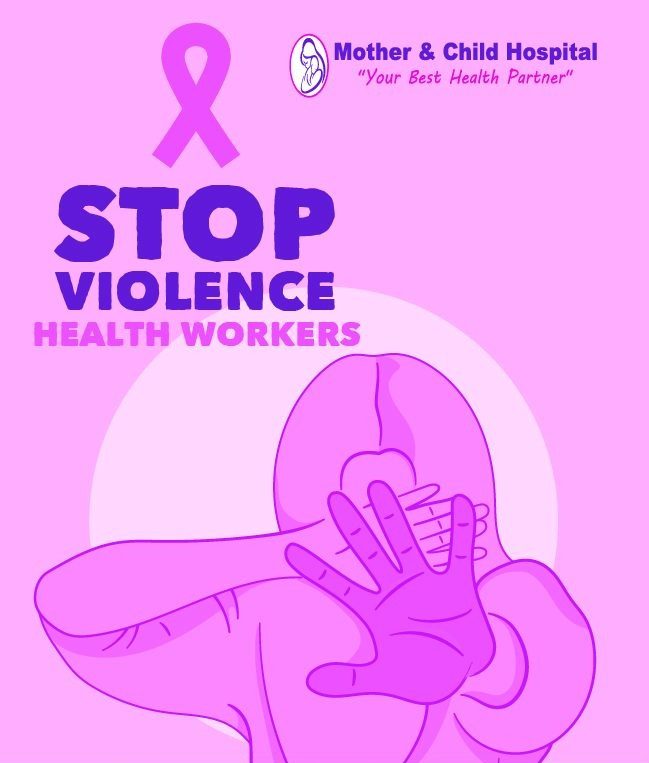
The Hands That Heal Should Never Bleed: Violence Against Health Workers in Kenya is an Emergency We Can No Longer Ignore
There is a photograph that has haunted me for weeks. A young nurse – barely two years out of training – sits on a plastic chair outside a rural dispensary. Her uniform is torn. Her lip is split. In her hand, she still clutches the stethoscope she was using moments before a patient’s relative knocked her to the ground.
Why? Because she asked a grieving family to wait for the doctor.
That nurse is not a statistic. She is someone’s daughter. Someone’s friend. And right now, somewhere in Kenya, she is wondering if showing up to work tomorrow is worth the risk to her life.
We at Mother & Child Hospital see her. We feel her. And we are raising our voice – not as a hospital trying to protect its image, but as human beings who have watched our fellow healers break inside.
An Emerging Epidemic We Refuse to Call by Its Name
When we talk about violence in Kenya, we talk about banditry, political unrest, or gender-based violence. Rarely do we talk about the nurse who is slapped at 2 AM because a mother in labor is crying too loudly. Rarely do we talk about the clinical officer punched in the chest because he requested a deposit before an emergency surgery. Rarely do we talk about the doctor held at knifepoint in a busy casualty ward because a family wanted “results immediately.”
But these things happen. Every single day. In public hospitals. In private hospitals. In faith-based facilities. And yes – even in places like ours, where we pride ourselves on being “Your Best Health Partner.”
The Kenya Medical Practitioners, Pharmacists and Dentists Union (KMPDU) has documented hundreds of cases over the last three years. Verbal abuse? Almost universal. Physical assault? Rising. Sexual harassment? Underreported, but painfully present. And the worst part? Most health workers never report it. Because they are told: “It’s part of the job.”
Let me stop you right there.
No. It is not part of the job to be beaten, cursed, or threatened while saving lives.
A Story We Cannot Forget
Let me tell you about a senior midwife we’ll call “Mama Esther” (not her real name, but her real tears). She works a night shift in a busy maternity wing. One evening, a young man stormed into the labor ward demanding to see his wife – even though visiting hours had ended two hours earlier. When Mama Esther gently explained the rules, he picked up a metal water jug and threw it at her head.
She fell. She bled. And the man? He walked away. No arrest. No apology. The next day, the hospital administration asked her to “understand the family’s stress.”
Mama Esther didn’t return to work for three weeks. Not because of the wound on her scalp – but because of the wound in her heart.
She told me: “I deliver ten babies a night. I hold women’s hands when they are dying. I clean blood and vomit and worse. And still, I am treated like an enemy. What am I doing wrong?”
Nothing, Mama Esther. You are doing nothing wrong. We are failing you.
Why Is This Happening?
We cannot fix what we refuse to understand. So let us be honest.
1. Lack of consequences.
Most attacks on health workers are treated as “minor disturbances.” Police are rarely called. Cases are rarely filed. And when they are, they disappear. The message is clear: a health worker’s body is not worth protecting.
2. Exhaustion and understaffing.
A tired nurse is an easy target. When hospitals are understaffed, waiting times grow, emotions boil over, and the first person to face the anger is the one wearing a white coat or scrubs.
3. A culture of entitlement.
Too many Kenyans have come to see healthcare as a service they can demand – sometimes violently – when they don’t get what they want, when they want it. Grief, fear, and frustration are real. But they are never excuses for assault.
4. No national conversation.
We talk about protecting policemen, teachers, and journalists. But when was the last time you saw a national campaign – beyond a poster like ours – calling for the protection of the very people who pull babies from wombs and stitch up bleeding bodies?
This Is Not a “Health Sector Problem.” It Is a Human Problem.
If your mother is a nurse, you care.
If your friend is a doctor, you care.
If your child hopes to be a clinical officer one day, you care.
But what if you don’t know any health worker personally? Then care because the next time you or someone you love lies on a hospital bed, gasping for breath, you will need that health worker to be present – not hiding in a store room, not trembling with fear, not applying for a job abroad because Kenya broke their spirit.
Violence against health workers does not just hurt individuals. It destroys healthcare systems. It empties hospitals of their best talent. It sends our brightest nurses to the UK, Canada, and Saudi Arabia – not for adventure, but for safety.
What Mother & Child Hospital Believes
We are not a large referral hospital. We are not a government institution. But we are a family. And families protect each other.
This is what we have started doing – and what we ask every hospital in Kenya to do:
-
Zero tolerance for violence. Any patient or visitor who attacks a health worker will be reported, banned, and pursued legally. No negotiations.
-
Panic buttons and security protocols. Our staff should never feel alone.
-
Psychological support. After an incident, we offer counseling – not a warning letter.
-
Reporting every case. We will name the problem until the nation listens.
But we cannot do this alone. We need the government to classify attacks on health workers as a specific criminal offense with mandatory jail time. We need the media to cover these stories not as “sad news” but as a national crisis. And we need you – the patient, the family member, the citizen – to look the health worker in the eye and say:
“I see you. I respect you. And I will not let anyone hurt you.”
A Letter to Every Health Worker in Kenya
To the nurse who is thinking of quitting tonight – please don’t. But also, we understand if you do.
To the doctor who has stopped wearing their name badge so that patients cannot look them up later and threaten them at home – we are sorry. We have failed to make your workplace safe.
To the clinical officer who secretly dreams of driving a matatu instead because at least road rage comes with witnesses – you are not weak. You are wounded. And we are fighting for you.
You chose this profession believing that your hands could heal. And they do. But those same hands should never have to wipe away your own tears before wiping a patient’s brow.
We at Mother & Child Hospital see your invisible scars. And today, we say loudly:
STOP VIOLENCE AGAINST HEALTH WORKERS. NOT SOMEDAY. NOW.
What You Can Do
-
Speak up. If you see a health worker being abused in any facility, intervene if safe, or call security/report it.
-
Share this article. Tag your local MP, the Ministry of Health, and the Kenya Police. Ask them: What are you doing to protect our healers?
-
Be a kinder patient. Grief is heavy. But words and fists are heavier. Breathe. Wait. Thank the person trying to help you.
-
Support the #StopHealthWorkerViolence campaign. Follow us on social media (0722 570 363 / www.motherandchild.hospital) for updates and ways to take action.
Because a nation that beats its healers is a nation that will soon have no one left to heal.
With hope, anger, and love,
Mother & Child Hospital
Your Best Health Partner – and your health worker’s protector.


1 Comment
Dee
This is what should happen. We look forward to a hospital, a country where the health worker is safe. Thanks for this piece.